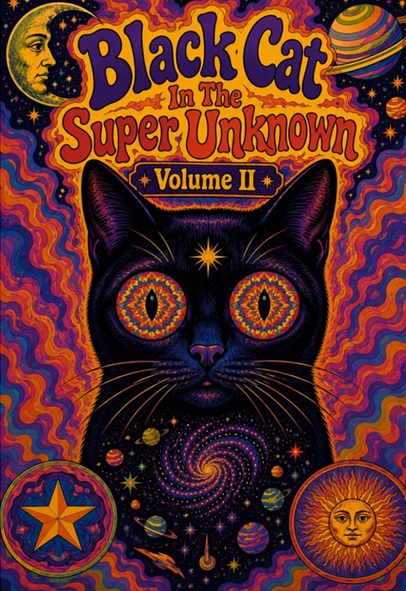
The Immersion Principle: Writing ‘Black Cat In The Super Unknown Volume II’

When I write, I immerse myself in it as much as I can, maybe more than I should. I live it, breathe it—everything. Until it’s done, I wear it like a second skin. Sometimes this depth of engagement feels necessary, even healthy; other times, it doesn’t. Case in point.
I recently finished a book of poetry that holds a lot of personal significance for me: Black Cat In The Super Unknown, Volume II. It emerged creatively from a period in my life that meant everything to me — a time now decades in the past. “Change equals progress,” they say. I suppose that’s true. The poetry channeled through me; I never set out to write any of it. It bubbled up from somewhere inside me, and before I knew it, manifested as words on my computer screen.
It resonated with me fiercely. All the memories of that era rushed back: I could hear the music I listened to, see the sights, smell the smells, and feel it all as if I had been transported back in time. From April to early July of this year, it stayed with me, never letting go. I even went so far as to search eBay for trinkets and artifacts from that period — objects of great personal significance — hoping to forge a deeper connection – and I did.
When it was all finished — or at least I thought it was back in June — I realized I had written a sequel to a previous poetry collection from several years ago. Perhaps “sequel” does it a disservice. It might be more accurate to describe it as further exploration of that subject matter: fleshing it out, examining it more closely, adding more “geography” to it, if that makes sense. This led me to re-edit the first book, which didn’t require much time, a few tweaks here and there, some revisions to tighten the language — and that’s when everything clicked and things got cosmic… and I started feeling off. My job was complete; there was nothing more to do.

These two books existed in perfect alignment with each other. In a strange way, it felt as though I had traveled back in time to that era I wrote about, and when both books were done — when they felt truly finished from my perspective — my journey was over. I had returned to the present day. That grip I mentioned earlier, the one that held me like a vise, was gone. I was released from it.
Obviously, I felt tremendous pride knowing what I had accomplished. But I also felt empty. I could no longer feel that period in my life the way I had. The music didn’t hit me anymore; the pop culture I wrote about felt distant, unreachable. As I write this essay, I still feel a sense of sadness, a longing, even a touch of depression. I accomplished my goal. I documented everything I needed to on paper, and that will forever be my legacy — it will live on as long as we have books, computers, the internet. Mission accomplished.
I suppose I’m writing this essay as a way to understand myself better — to consider whether I should deep-dive into another project the way I did this one, whether I should allow myself to become that immersed again. I think, though, that my connection to the pop culture I explored (music, TV, movies) — will return in time. Distance and perspective are probably what I need at the moment before I can approach it all again and begin writing at some later date.
But the books are magnificent: Black Cat In The Super Unknown and Black Cat In The Super Unknown, Volume II. I’m not sure critics will connect with them, but I hope anyone who reads them will appreciate the words I’ve laid down and feel the groove, the vibe, and especially the psychedelic atmosphere I’ve worked to create. If not, it’ll be something more intimate — something just you and me and maybe a handful of others will appreciate.