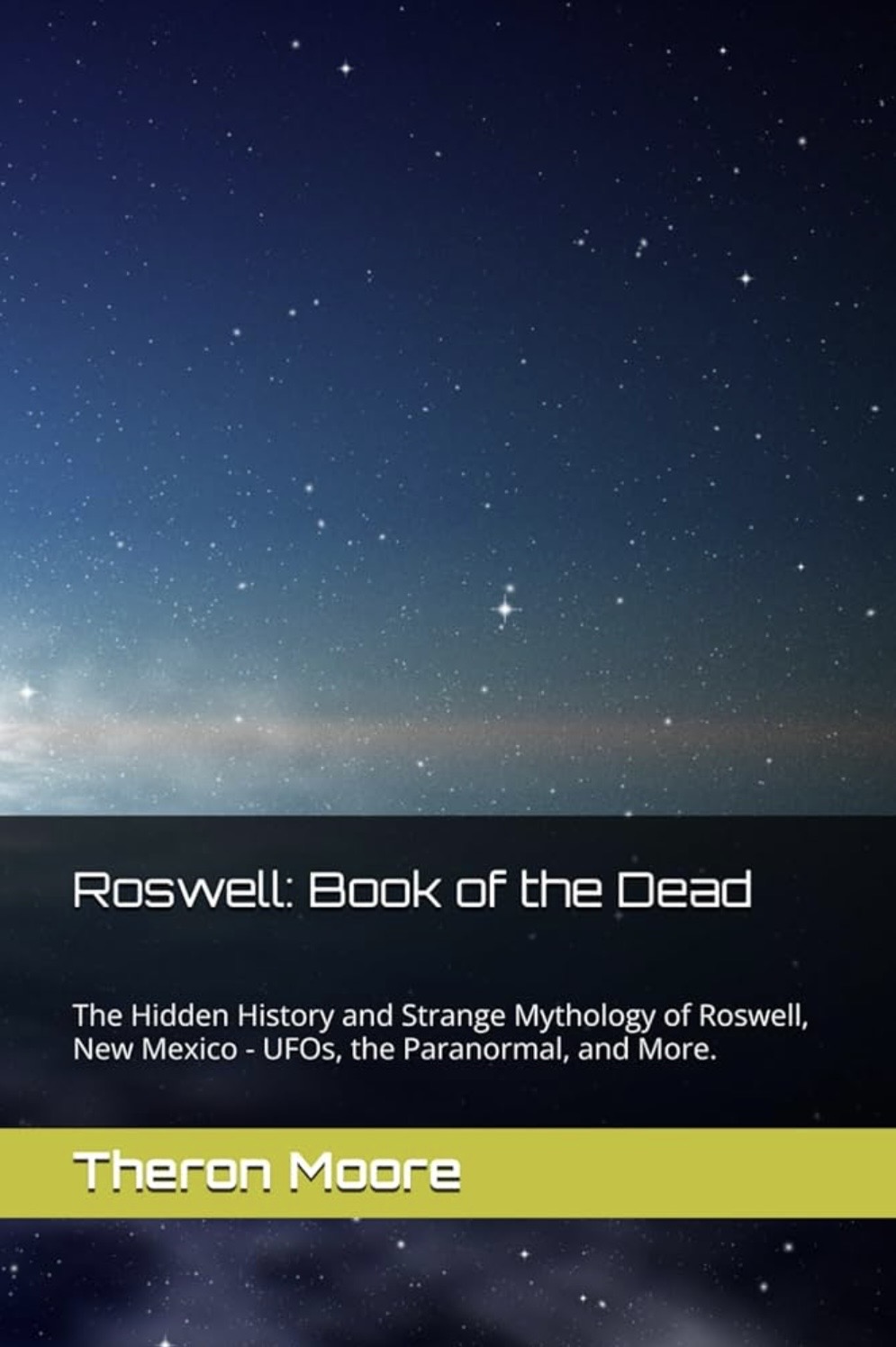
The Non Linear Approach To Writing With Roswell: Book Of The Dead

Roswell: Book Of The Dead is built in non-linear fashion—deliberately, unapologetically. You won’t find the traditional three-act structure here, no protagonist’s journey from beginning to middle to end, no conventional plot arc that resolves itself in the final pages. That’s not what this book is.
Instead, I wanted to create something that challenges you intellectually, unnerves you, makes you question what’s fiction and what might actually be true. I built it from short bursts of information, snapshots in time that capture events as they unfold, then shift to something else entirely. Think of it as a mosaic rather than a mural—each piece has its own integrity, but step back and you see the larger, unsettling picture.
The beginning of the book introduces “The Dark Prince,” a mysterious figure who gifts the author several storage lockers filled with classified documents, locked safes containing reel-to-reel footage, and plastic totes crammed with decades-old photographs. This framing device isn’t just narrative convenience—it’s the book’s DNA.
Roswell: Book Of The Dead functions as that metaphorical storage unit. You, the reader, are invited inside to explore its contents. Some items will connect immediately. Others reveal their significance only after you’ve moved deeper into the space. That’s why the structure had to be non-linear—you don’t explore a storage unit by following a predetermined path.
Think of David Lynch’s Twin Peaks, Lost Highway, or Mulholland Drive. His work confounded viewers precisely because it refused conventional storytelling. He employed surreal atmospheres, wove narratives that sometimes connected and sometimes remained beautifully, mysteriously separate. These works are brilliant because Lynch trusted his audience to engage with ambiguity, to sit with discomfort, to make their own connections. They’ve stood the test of time because of their unconventionality, not despite it.
When I tell people I’ve written a book about Roswell, they light up. When I mention there are no traditional main characters or linear plot, I see hesitation. That’s natural—it’s different from what we’re conditioned to expect. But different doesn’t mean difficult.
This book offers insider access to something larger. Are UFOs real? Is there proof of the paranormal? What makes Southeastern New Mexico—and Roswell specifically—such a nexus of strangeness? The answers exist within these pages. I’m just testifying, that’s all.
Roswell: Book Of The Dead is better understood as a container of cosmic mythology, hidden history, and legendarium. It’s world-building that extends beyond its own pages, connecting to locations and events in Lake Dungeoneva, the sequel. The more you engage with it, the more it reveals—and the more it’ll likely unsettle you.
The framework for understanding Southeastern New Mexico’s strangeness lives in this book. Whether we’re talking about the 1947 UFO crash or something more cosmically sinister, the foundation is here. I brought you inside the Duggar Test Complex, showed you what’s hidden from public view, explained why it needs to stay that way.
This is reader-immersive experience by design. You can pick it up, set it down, return to it weeks later, and still find your way. Each section has its own integrity while contributing to the larger mythology.
The book invites a particular kind of engagement—open, curious, willing to make connections across fragments or snapshots in time. If you approach it looking for traditional continuity, you’ll be reading against the grain. But if you’re willing to explore, to piece together the mosaic, to sit with uncertainty, Roswell: Book Of The Dead has considerable rewards to offer.
Welcome to the storage unit. The door’s open.